On this page
- Work out which document you've been given
- Who can bring one against you
- What the magistrate has to be satisfied of
- Fighting a DVO in Queensland
- Your four options at the mention
- If you just don't turn up
- How long an order lasts
- Conditions on a domestic violence order
- Children and other people on the order
- Whether a DVO gives you a criminal record
- What a DVO does affect
- Changing an order later
- If you've been served and you have a date at Cairns Magistrates Court
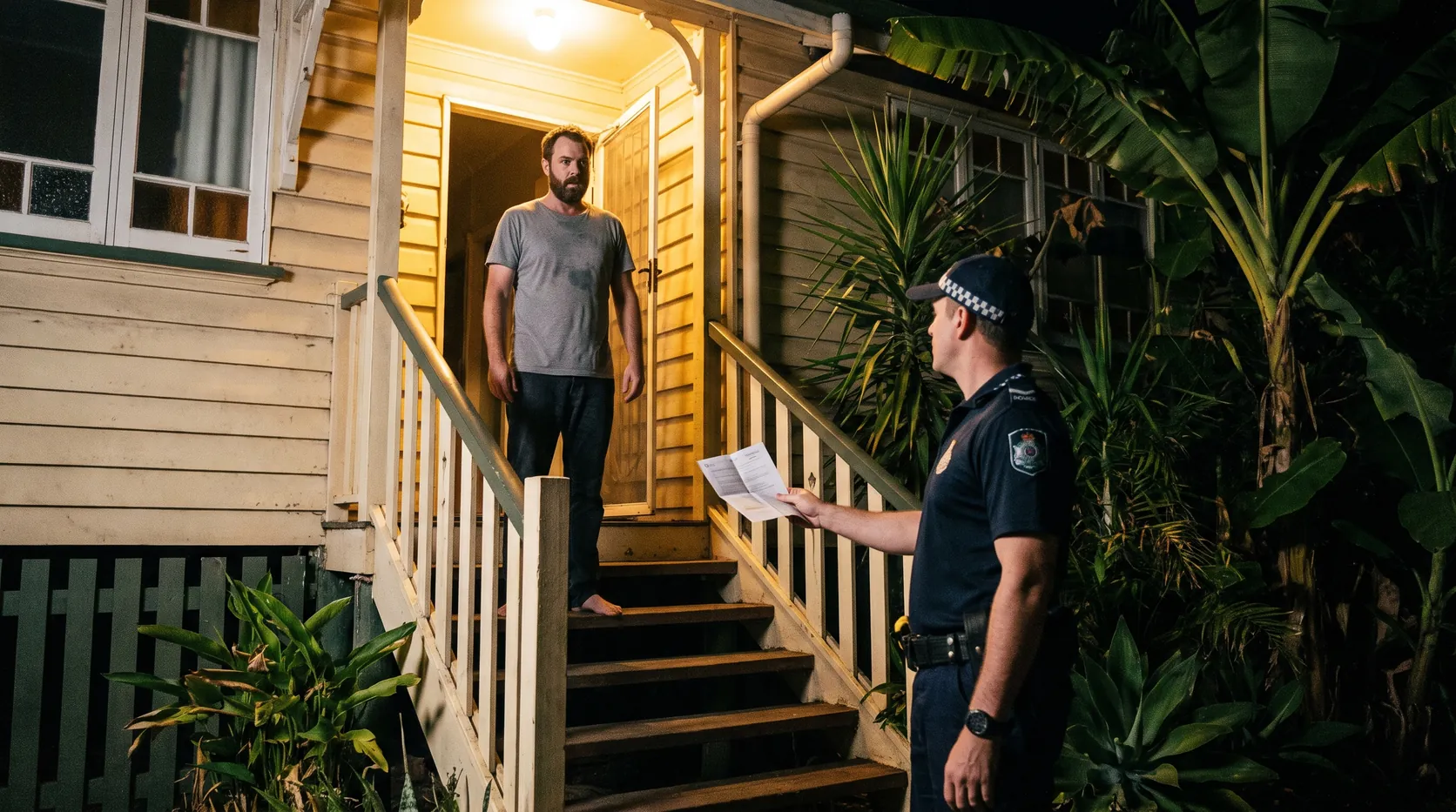
Getting served with an application for a domestic violence order is a lot to take in. Many people reach for their phone and search how to fight a DVO in Queensland before they've had a chance to read the document properly.
That's understandable, but slow down first, because what's in the application shapes what your options are.
You have four real options, and which one makes sense depends on what's being asked for and what you need to protect. That might be your job, your firearms licence, your blue card, where you're going to sleep or when you'll see your kids, and they're not all affected the same way.
Work out which document you've been given
There's more than one document that can land on you here, and they work differently.
An application for a protection order is a court application. It has a date on it and you need to be there.
A temporary protection order is a short term order a magistrate can make while the application is still running. Queensland Courts describes it as being for people in immediate danger, lasting until a magistrate can decide the main application. One can be made at any mention, including when you're not there.
A police protection notice is issued by police and counts as an application to a court, so it brings you to court.
A police protection direction is a different thing again. The Queensland Government records these as starting statewide on 1 January 2026. Police issue it, it runs for 12 months, and it does not go to court the way a notice does. If that's what you've got, your path is a police review or a court review, not a mention date, and the timeframes are tight. Our page on police protection orders covers those.
Work out which one you're holding before anything else. People do turn up to court on a direction, and people do set a notice aside thinking it's a direction, and each of those creates a different problem.
Who can bring one against you
Under the Domestic and Family Violence Protection Act, an application can come from the person seeking protection, someone authorised to act for them, a police officer, or a person acting for them under another Act.
Police can apply on someone's behalf, and Legal Aid Queensland is explicit that they can do it even if that person doesn't want them to.
That surprises people, because the common assumption is that the order goes away if the other person doesn't want it. That isn't necessarily so, and once police are running the application, their view is what drives it.
What the magistrate has to be satisfied of
The magistrate has to be satisfied of all three of these things:
- that you and the other person are in a relationship the Act covers
- that you've committed domestic violence against them
- that an order is necessary or desirable to protect them
That third one is broader than people expect, and it's often where these applications are decided. If you're looking for the reference, it's section 37 of the Domestic and Family Violence Protection Act.
The Act was also amended with effect from 1 January 2026 so that a court can't refuse to make an order just because you complied with an intervention or diversion order, or just because a police protection direction is already in place.
Fighting a DVO in Queensland
You can oppose the application and have a magistrate decide it after hearing evidence. Whether you should is a separate question, and it's one to think through honestly.
Contesting means a hearing gets listed, evidence gets called, and the other person will usually have to give evidence and be cross-examined. It takes months and it costs money, and in the meantime there'll often be a temporary order in place, so you're living under conditions either way.
If the allegations are simply wrong, and an order would do real damage to your work or your life, contesting may be exactly right. If the practical difference between contesting and not contesting is small, it may not be worth what it takes out of you. Nobody can tell you in advance how a contested hearing will end.
Your four options at the mention
These are the courses open to you when responding to a domestic violence order, and which one fits depends on what is being sought.
Consent
You tell the magistrate you agree to the order, and it gets made.
Consent without admissions
Most people have never heard of this option. You can agree to an order being made without agreeing with any of the things said about you in the application. Legal Aid Queensland describes it exactly that way, and Queensland Courts puts it as agreeing to the order even if you don't admit the allegations.
It does mean an order is made against you, it's just as enforceable as any other, and breaking it is a criminal offence. It doesn't mean you've admitted anything, and the order by itself doesn't give you a criminal record.
For some people that's a sensible way out. It ends the proceeding without a hearing and without conceding the facts. For others, the conditions being asked for are the real problem, and agreeing to those isn't something to do lightly. The conditions are often more negotiable than whether an order gets made at all.
Ask for more time
You tell the magistrate you need time to get advice. This is a completely normal request. A temporary order may be made while you wait.
If you've just been served and your date is close, this is usually the first thing to ask for rather than making a decision cold in a corridor.
Contest it
You say you oppose it, and a hearing date gets set.
If you just don't turn up
The court can make an order without you there. Legal Aid Queensland says that can be an order lasting up to five years.
Staying away won't help your position. If you can't be there, get advice about it beforehand rather than simply not appearing.
How long an order lasts
Queensland Courts says an order usually lasts five years, unless the magistrate sets a different end date. A shorter period is possible, and where one is set the court has to give reasons for it.
Five years is the standard period and isn't reserved for the worst cases, so do not agree to something on the assumption it'll be over soon.
Conditions on a domestic violence order
The Act requires every order to carry standard conditions. Put simply, you must be of good behaviour towards the other person, must not commit domestic violence against them, and must not get someone else to do what you can't do yourself. Queensland Courts describes the same obligations extending to anyone else named on the order.
Beyond that, the Act allows the court to add more, such as no contact conditions, ouster conditions that remove you from your own home, and conditions about not going near a child's school or daycare.
Most of the real negotiation happens over these conditions. An order with just the standard conditions may be an inconvenience, while one with an ouster condition can leave you with nowhere to sleep tonight.
Children and other people on the order
A court can name children on an order. Queensland Government material describes the basis as the court finding it necessary or desirable to protect the child from associated domestic violence, or from being exposed to domestic violence. Queensland Courts notes that relatives and associates can be named too where they're at risk.
If you have kids, and there are family law proceedings running or likely, how a DVO interacts with parenting arrangements needs thinking about now rather than after the order is made. Getting that sequence wrong is expensive to unwind.
Whether a DVO gives you a criminal record
A DVO does not give you a criminal record, which is a common worry, and on this point the published guidance is clear.
Queensland Courts says plainly that a DVO won't go on your criminal record, but breaching it is a criminal offence. Legal Aid Queensland says the same thing, that it won't unless you breach it.
The order itself is a civil order, and the criminal risk comes from breaking it.
What a DVO does affect
Two things catch people out badly.
The first is firearms. Queensland Courts states that a temporary order suspends a weapons licence and a final order cancels it, and that you can't apply for a new one for five years from the date of the order. If you shoot, or work with firearms, or need a licence for your job, that has to be on the table from the first conversation rather than discovered later.
The second is blue cards. Queensland Government material identifies domestic violence orders, police protection notices and police protection directions as matters that can trigger a blue card risk assessment. If you work with children, that's a live issue for you.
Changing an order later
An order isn't necessarily permanent. Queensland Courts states that the respondent, the aggrieved, the applicant or a named person can apply to change it.
Queensland Government guidance describes the test as the court being satisfied that the safety, protection or wellbeing of the protected person, and anyone named, won't be adversely affected by the change. A magistrate may well ask whether anyone pressured you into applying, and why you want it changed.
A variation can add or remove conditions, add or remove named people, or change how long the order runs.
If you've been served and you have a date at Cairns Magistrates Court
What you decide at that first mention can shape the next several years. It's worth more than the five minutes before your name is called, with the application still folded in your pocket.
We act for respondents in domestic violence matters in Cairns. Understanding what's being asked for, and what your options are, is work best done before your court date. You can also read more about responding to a domestic violence order.
If a domestic violence order application has been made against you in Cairns, speak with us before your court date.
This article is general information about Queensland law. It is not legal advice. Every matter turns on its own facts, so speak with us about yours.

When you call Coral Coast Law, you speak directly with principal Joseph Rahim, and he handles your matter himself. Your first consultation is free and confidential.
About Joseph